
Distance slows things down.
High latency and packet loss can severely limit conventional TCP transfers, especially over long-distance connections.
LATENCY & PACKET LOSSYour network is fast. Your file transfer should be, too.
Move massive files directly and securely with CROSSBOW.
01 / THE PROBLEM
Hundreds of gigabytes. Teams on different continents. A deadline that won't move. Even a fast network can leave your files — and your work — waiting.
High latency and packet loss can severely limit conventional TCP transfers, especially over long-distance connections.
LATENCY & PACKET LOSSA dropped connection shouldn't mean sending a massive file all over again. Repeated retries hold up the next step.
INTERRUPTED WORKFLOWSUpload to a cloud. Download again. Every extra stop adds waiting, another data location, and potential transfer costs.
EXTRA STEPS & COSTS02 / THE SOLUTION
CROSSBOW is a high-speed file transfer solution that connects offices, partners, and data centers directly. Put the network you already have to work.

No cloud staging.Files travel directly between your endpoints, without an intermediate cloud upload.
No relay in the data path.Your files don't pass through CROSSBOW's infrastructure on their way to the destination.
Works inside isolated networks.Transfer within a closed network, even when internet access isn't available.
03 / BUILT IN-HOUSE
Two proprietary engines. Developed in-house for massive files, long distances, and challenging networks. Each handles a different part of the journey.
Our reliable, high-speed UDP transport engine recovers packet loss and is designed to sustain data flow across high-latency, long-distance networks.
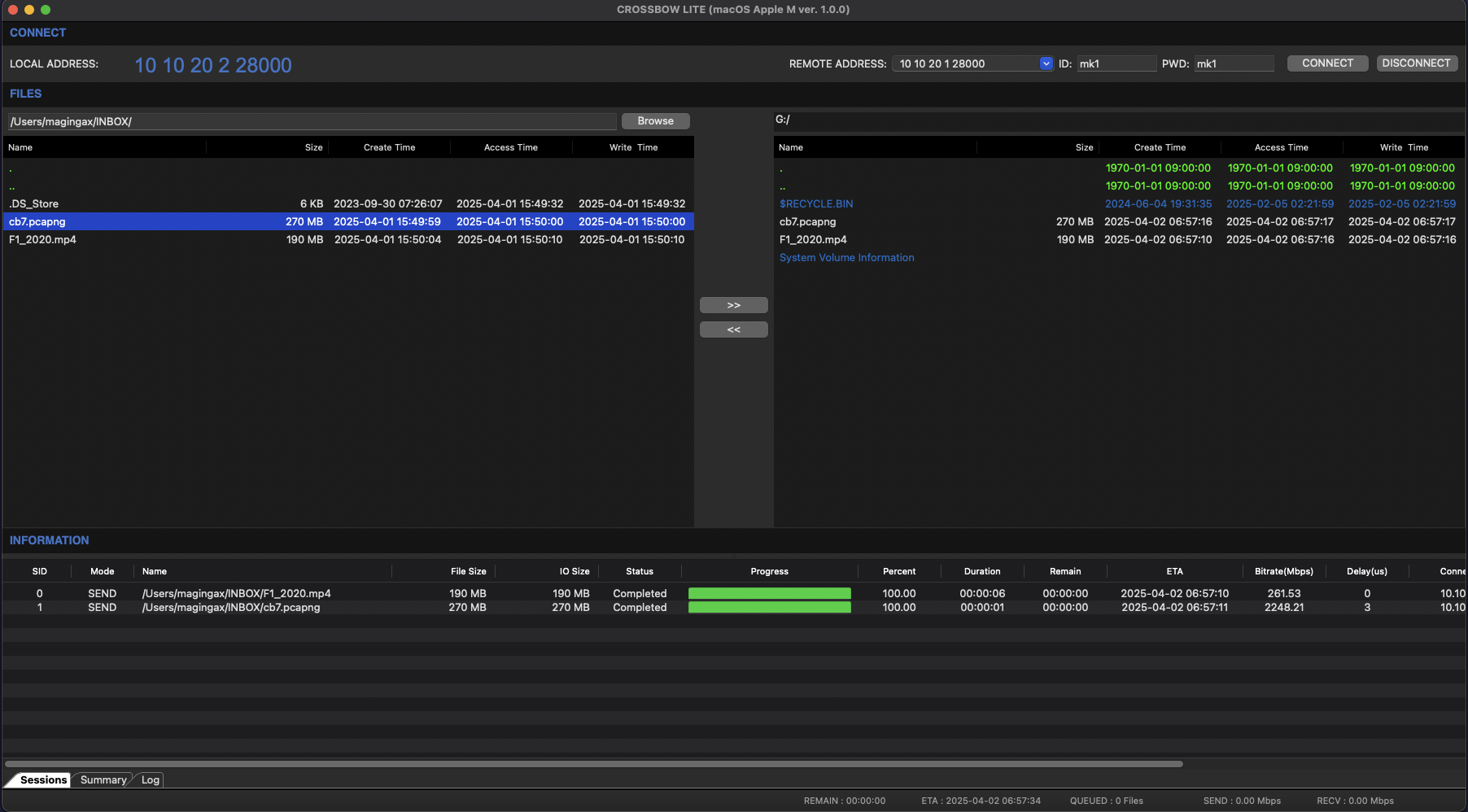
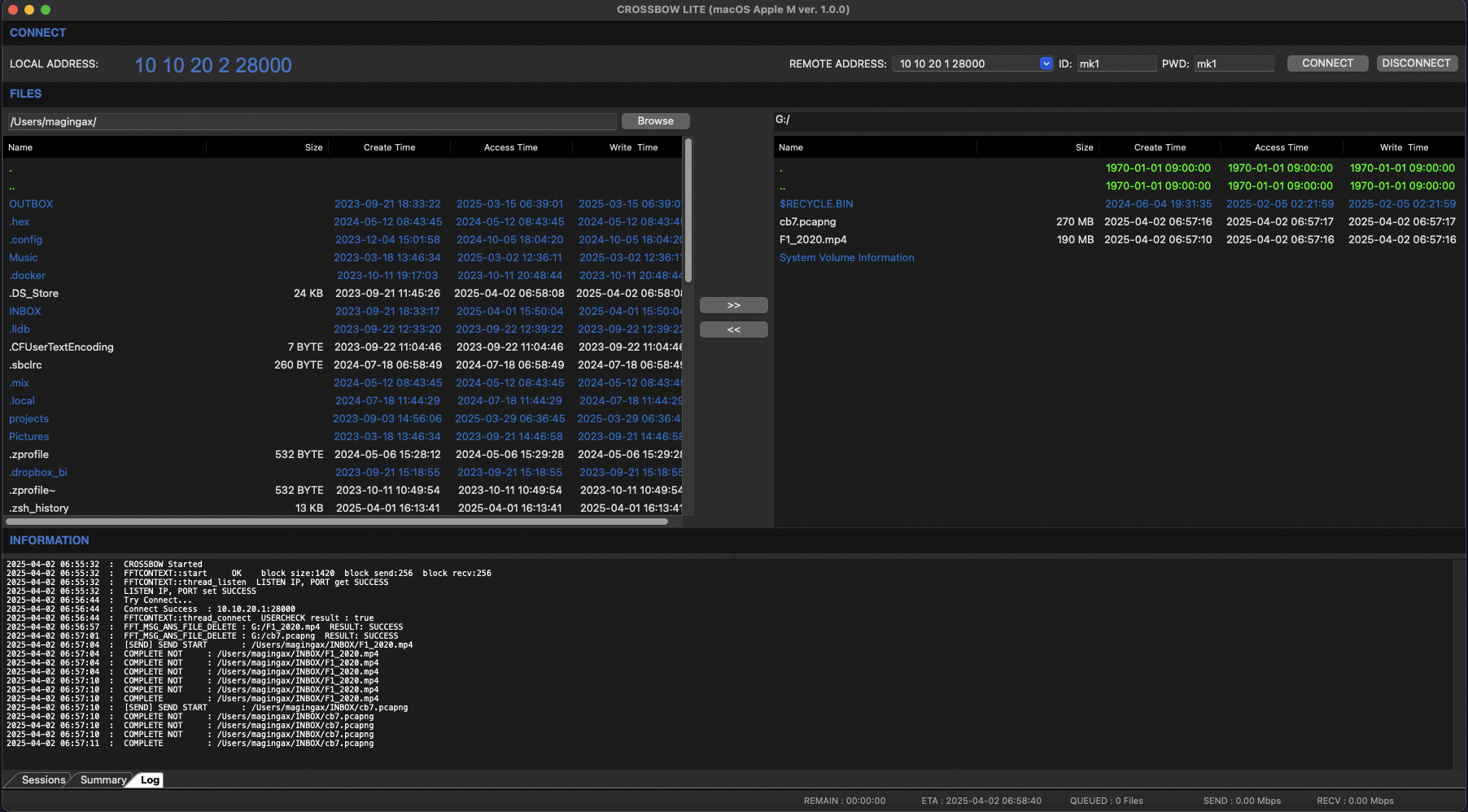
Built on MKUDP, our file transfer engine manages large-file data movement, verifies received files, and resumes interrupted transfers.
INSIDE CROSSBOW

04 / SECURITY AT THE CORE
Your most important files deserve more than a fast connection. Protection is built into the transfer.
Protect data in transit with encryption between the sending and receiving endpoints.
Keep files off third-party cloud storage and transfer directly to the destination you choose.
Verify received files and resume interrupted work without starting the entire transfer over.
05 / REAL IMPACT
Make file transfer a working part of your workflow. Spend less time managing the handoff and more time on what comes next.
Use available bandwidth more effectively to move large files and keep production moving.
Continue interrupted transfers and verify the result, instead of repeating hours of work.
One server license supports unlimited partners and clients, with no usage-based data charges.
Part of real production workflows since 2021. Teams and partners that have used CROSSBOW include:
06 / FREE EVALUATION
The best benchmark is your own workflow. Try CROSSBOW for free.
Test the speed, interrupt a transfer, resume it — then decide.
Choose your setup.Download the right edition for your platform and role.
Use your real files.Test the routes and network conditions you work with.
See the difference.Check speed and recovery. Decide with real evidence.
07 / DOWNLOAD
FULL for your central server.
LITE for your partners, vendors, and collaborators.
Choose your platform to get started.
CROSSBOW for Windows
Apple Silicon
Rocky 8 · x86_64
Downloads open in Google Drive. For evaluation terms and licensing, contact [email protected] ↗
FULL is the central server edition. LITE is the client edition for partners, vendors, and collaborators. Contact [email protected] for help choosing a setup that fits your workflow.
Yes. CROSSBOW can operate inside isolated networks without internet access. Contact our team to discuss your network configuration and deployment requirements.
Actual performance depends on bandwidth, latency, packet loss, storage performance, and other conditions. Use the free evaluation to test your own files and endpoints on the routes you use every day.
Download the appropriate platform and edition above. For evaluation terms, initial setup, and licensing guidance, email [email protected].